
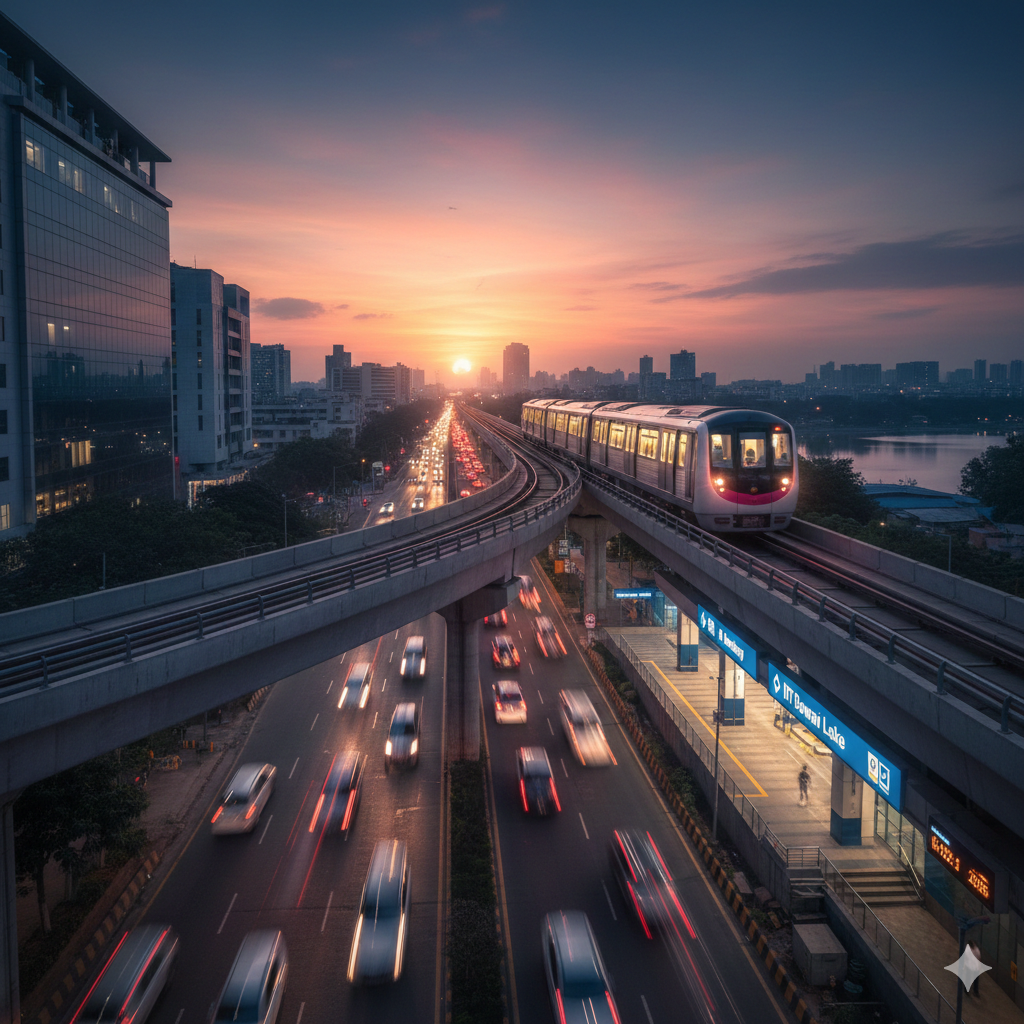
MUMBAI – In a significant boost to Mumbai’s public transportation infrastructure, the development of Metro Line 6 is nearing a critical milestone. Spanning 15.31 kilometers, this fully elevated corridor is poised to become a lifeline for thousands of commuters, bridging the gap between the Western and Central suburbs while bypassing the city’s notorious road congestion.
Commonly referred to as the Pink Line, Metro Line 6 connects Swami Samarth Nagar in Lokhandwala (Andheri) to Vikhroli (Eastern Express Highway). According to recent progress reports, over 75% of the civil construction work has been completed, signaling that the project is steadily moving toward its operational phase.
Strategic Connectivity and 13 Key Stations
The corridor features 13 strategically located stations designed to serve high-traffic residential and commercial hubs. The planned stations include:
- Swami Samarth Nagar (Lokhandwala)
- Adarsh Nagar
- Jogeshwari (West)
- JVLR
- Shyam Nagar
- Mahakali Caves
- SEEPZ Village
- Saki Vihar Road
- Ram Baug
- Powai Lake
- IIT Bombay
- Kanjurmarg (West)
- Vikhroli (EEH)
By traversing the Jogeshwari-Vikhroli Link Road (JVLR), the line provides a much-needed alternative to one of the city’s most congested arterial roads. For residents of Lokhandwala and Powai, the metro promises to slash travel times by nearly 50%, offering a climate-controlled, rapid transit alternative to the gridlock of the streets below.
Integration with the Suburban Network
One of the most impressive engineering feats of Line 6 is its integration with Mumbai’s existing transit ecosystem. The elevated tracks are designed to overlap with both Central and Western Railway lines, as well as existing and upcoming metro routes.
Notably, the corridor will intersect with Metro Line 7 (Red Line) at Jogeshwari, allowing for seamless transfers between the North-South and East-West corridors. This “multi-modal” approach ensures that the metro isn’t just an isolated route but a vital gear in the city’s larger transportation engine. Furthermore, its proximity to the Kanjurmarg and Jogeshwari railway stations will allow commuters to transition easily from the suburban local trains to the metro network.
Boosting Economic and Urban Growth
Beyond just shortening commutes, Metro Line 6 is expected to spark economic growth along its path. Areas like Powai and SEEPZ, which are major employment hubs, will benefit from improved accessibility, potentially leading to increased real estate demand and commercial development.
The project is being executed with a vision for the future. The design accommodates high-capacity rolling stock and modern signaling systems, ensuring that as the city grows, the metro can scale its operations to meet increasing demand.
Environmental and Social Impact
As an elevated corridor, Line 6 has been designed to minimize ground-level disruptions during both construction and operation. By encouraging thousands of commuters to shift from private vehicles to public rail, the project aims to significantly reduce the city’s carbon footprint and improve air quality along the JVLR belt.
As Mumbai continues its transformation into a world-class metropolis, Metro Line 6 stands as a testament to the city’s commitment to modern, efficient, and sustainable urban mobility. With three-quarters of the civil work already in the rearview mirror, Mumbaikars are now looking forward to a future where the “East-West divide” is a thing of the past.