
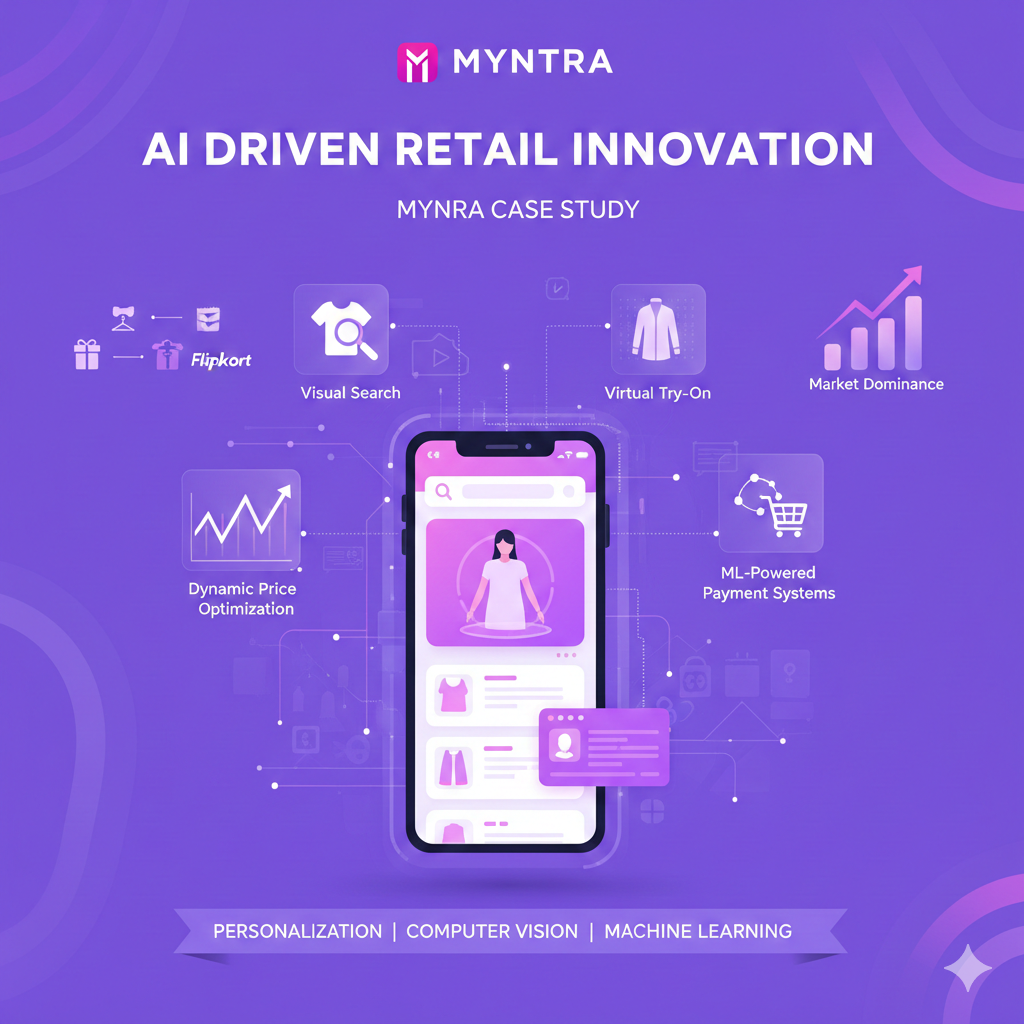
Artificial Intelligence (AI) has emerged as a cornerstone in the evolution of the modern e-commerce industry. By enhancing customer experiences, optimizing brand reputation, and driving organizational growth, AI solutions have transformed how retail operates in a digital-first world. This case study focuses on Myntra, a premier Indian fashion e-commerce platform, which has strategically integrated multiple AI technologies to maintain its market leadership
. Through the application of machine learning (ML), computer vision, and data analytics, Myntra has redefined personalized shopping, logistics, and trend forecasting. This document explores the technological framework, market dominance, and user impact of Myntra’s AI initiatives.
1. Introduction to Myntra’s Evolution
Founded in 2007 by Mukesh Bansal, Vineet Saxena, and Ashutosh Lawania, Myntra began as a Business-to-Business (B2B) platform specializing in personalized gift items. The company made a pivotal shift toward the fashion and lifestyle sector in 2011, a move that eventually led to its acquisition by Flipkart in 2014 for approximately Rs. 2,000 Crore.
Today, Myntra is a household name in India, offering a vast array of apparel, footwear, accessories, and cosmetics from both international giants—like Nike, Adidas, and Puma—and local brands. Beyond its product range, Myntra’s competitive edge lies in its technological sophistication, particularly its use of AI to create a seamless, customized shopping journey for millions of users.
2. Market Dominance and Growth Trajectory
Myntra’s strategic use of technology has translated into significant market success. As of August 2023, Myntra held the top position in the Fashion and Apparel retail segment in India.
2.1 Key Performance Indicators (KPIs)
- Web Traffic: Myntra recorded over 70 million visits in a 90-day period leading up to August 2023, significantly outperforming competitors like Ajio and Bewakoof.
- User Engagement: The average visit duration is approximately 4 minutes and 31 seconds, with users viewing over 6 pages per session.
- Revenue Growth: Despite a dip in FY 2017-18, the platform recovered rapidly. In FY 2021-22, Myntra reported a revenue of Rs. 3,610 Crore, up from Rs. 2,466 Crore in the previous fiscal year.
3. Core AI Technologies Driving Myntra
Myntra’s operational efficiency is powered by a suite of AI and ML solutions designed to address specific retail challenges.
3.1 Personalized Product Recommendations
Personalization is at the heart of Myntra’s user experience. By analyzing user data—including browsing history, search queries, and past purchases—ML algorithms curate a unique “storefront” for every individual.
- Impact: Industry data suggests that such personalization can lead to a 55% increase in visitor engagement and a 51% rise in lead conversion rates.
3.2 Visual Search and Computer Vision
Myntra utilizes computer vision to identify colors, patterns, and shapes within images. This allows the platform to:
- Enhance Product Discovery: Users can search for items using images, a trend that has seen nearly 180% growth in Indian e-commerce.
- Forecast Trends: By analyzing social media and usage patterns, Myntra can predict and generate fashion that satisfies consumer needs faster than traditional manufacturers.
3.3 Virtual Try-Ons
To address the high return rates common in online fashion, Myntra has explored virtual try-on technology. This tool allows customers to visualize how products look on them, which has been shown to boost buyer confidence and reduce the logistical burden of returns.
3.4 Dynamic Price Optimization
Myntra employs dynamic pricing models based on deep reinforcement learning. These algorithms analyze market trends and consumer demand in real-time to adjust prices, ensuring competitive positioning and maximized revenue.
3.5 ML-Powered Payment Systems
To mitigate the high failure rates of Indian banking systems, Myntra uses ML to optimize payment collection. The system intelligently switches between multiple payment gateways (such as PayU, PhonePe, and Paytm) based on real-time success rates to ensure a smooth transaction experience.
4. Literature Survey: The E-Commerce Landscape
Research into the sector highlights several critical areas where Myntra and its competitors operate:
- Visual Search: Studies like “ViSeR” emphasize that visual search increases conversions but remains dependent on high data quality.
- Virtual Try-On: While effective at reducing returns, these technologies involve high development costs and technical constraints.
- Dynamic Pricing: While beneficial for inventory management, rapid price changes can lead to customer suspicion if not implemented transparently.
5. User Sentiment and Survey Analysis
A survey involving 1,264 respondents provided insights into how consumers perceive Myntra’s AI-driven platform:
- Platform Interaction: 60.4% of participants reported regular interaction with Myntra.
- Product Listing Satisfaction: 59.3% of users expressed satisfaction with how products are displayed and their ability to find favorite brands.
- Trend Leadership: 52.3% of respondents believe Myntra is the premier platform for the latest fashion trends.
- Overall Experience: The platform received a positive rating from 78.4% of users, though 21.6% reported negative experiences, highlighting areas for continued improvement.
6. Discussion: Results and Strategic Advantages
The integration of AI has provided Myntra with a formidable competitive advantage. By utilizing social media marketing and personalized notifications (received by 57.5% of surveyed users), the brand maintains constant engagement with its audience. Furthermore, the use of computer vision in headquarters-led operations shows a commitment to automating fashion generation at an “impossible” rate for traditional retailers.
However, the case study also notes challenges. Users have noticed the effects of dynamic pricing, with 60.2% observing price changes for items they were tracking. Additionally, maintaining data privacy and system accuracy remains a critical benchmark for future innovation.
7. Conclusion
Myntra’s journey from a small B2B startup to a dominant e-commerce giant serves as a blueprint for AI integration in retail. By successfully implementing personalized recommendations, visual search, and virtual try-ons, the company has enhanced customer satisfaction and operational efficiency. As AI continues to evolve, Myntra’s focus on computer vision and machine learning will likely remain the primary drivers of its ability to set new benchmarks in the Indian fashion industry